The Only Harmless Great Thing
Cutting Room Floor

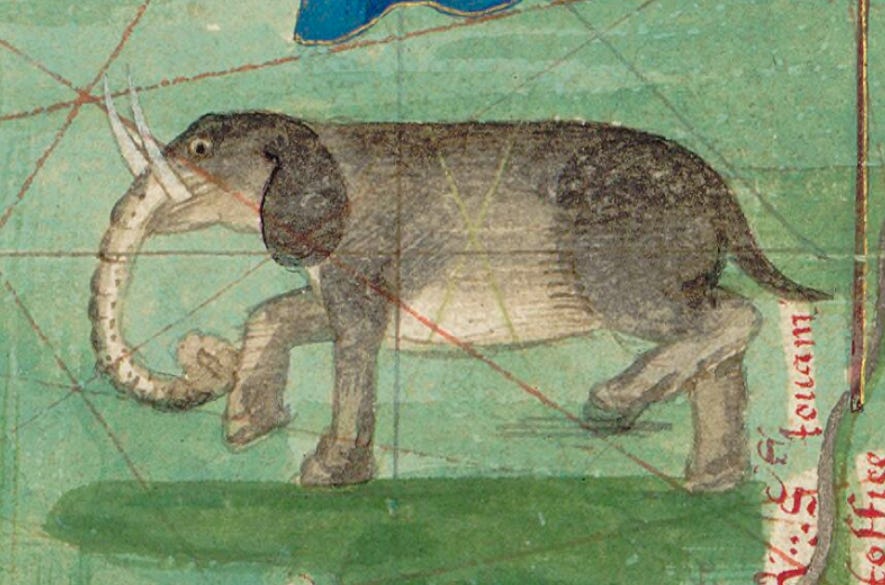
In his 1601 poem “The Progress of the Soul,” John Donne wrote a few lines inspired by an elephant he saw on display at the Tower of London.
Natures great master-peece, an Elephant,
The onely harmlesse great thing; the giant
Of beasts; who thought, no more had gone, to make one wise
But to be just, and thankfull, loth to offend,
(Yet nature hath given him no knees to bend)
Himselfe he up-props, on himselfe relies,
And foe to none, suspects no enemies,
Still sleeping stood; vex’t not his fantasie
Blacke dreames; like an unbent bow, carelesly
His sinewy Proboscis did remisly lie
This might not seem like a French Atlantic story, but it is. To paraphrase Lewis Black: it’s like six degrees of Kevin Bacon, but there’s only one degree and Kevin Bacon is French.
Donne’s beast and his sinewy proboscis had arrived in London nine years earlier, in 1592, as a gift from France’s King Henri IV to Elizabeth I. Like many gifts, this one says more about the giver than the receiver. The queen had not asked for an elephant. She didn’t seem to want one. What she’d done, instead, was to license a group of English merchants to trade on the West African coast, targeting the area between the Senegal and Gambia Rivers where French traders had dominated for the past two decades.
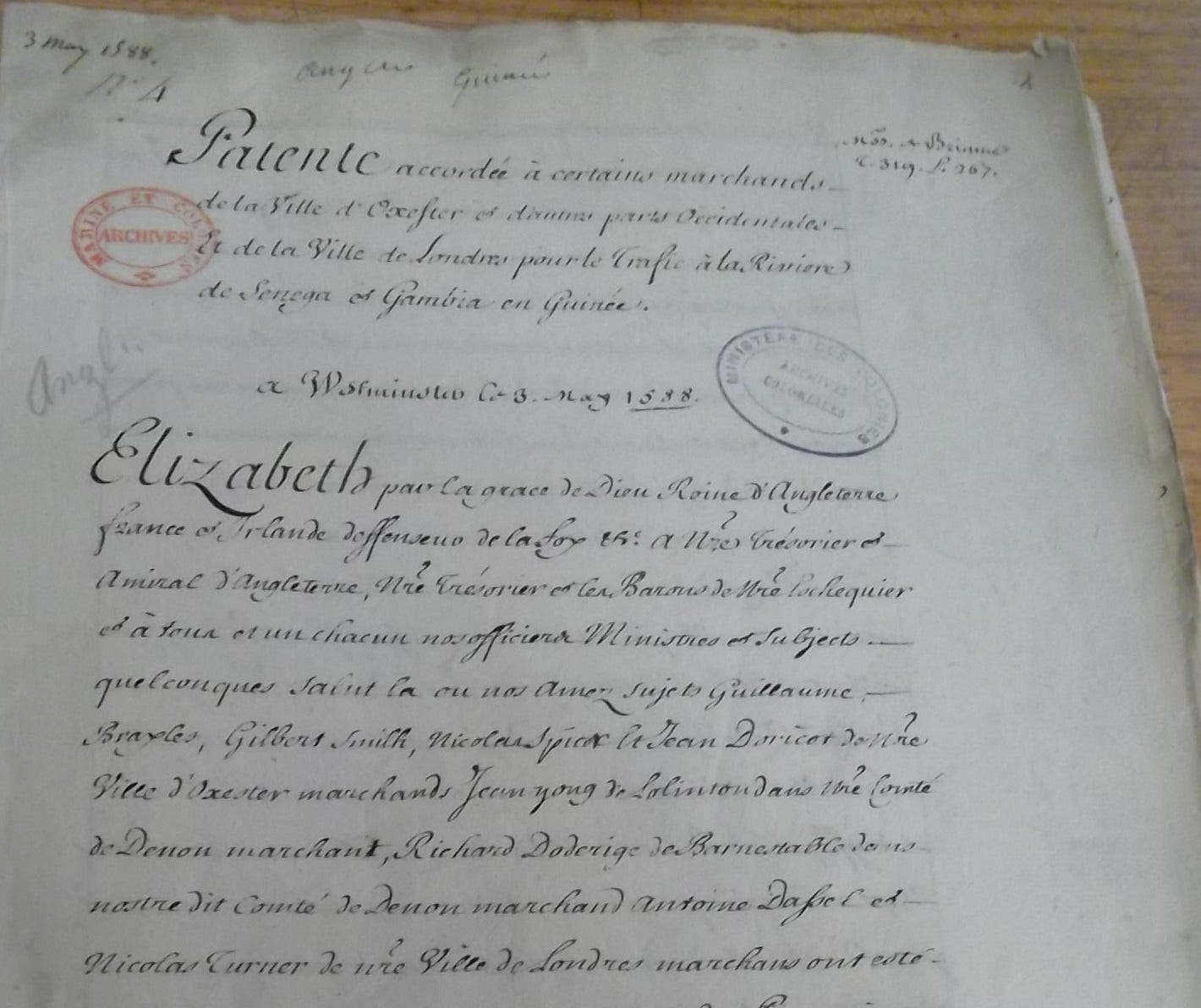
If you haven’t read chapter 2 of Beyond the Ocean, it might surprise you that about 5,000 French people sailed to West Africa between 1580 and 1588, when Elizabeth granted the trade licenses. When Henri IV became king the next year, he looked for a polite way to ask Elizabeth to back off and leave Senegambia to the French. Instead of sending threats, he sent an elephant. Specifically, a young female forest elephant and her two Flemish caregivers. You want the things of Africa in England? I can help you with that. Passive aggression on a royal scale.
(Elizabeth might have wondered, with John Donne, “Whie have Bastards the best fortunes?”)

Henri’s flex capped a century of French trade and cultural exchange in western Africa. How that unfolded, and why it’s important, is the subject of our second chapter. It focuses on three regions where French activity was the most intense: the Pepper Coast (modern Liberia and Ivory Coast), the Gold Cost (mostly modern Ghana but also nearby areas in the Gulf of Guinea), and Upper Guinea (from Senegambia to Sierra Leone).
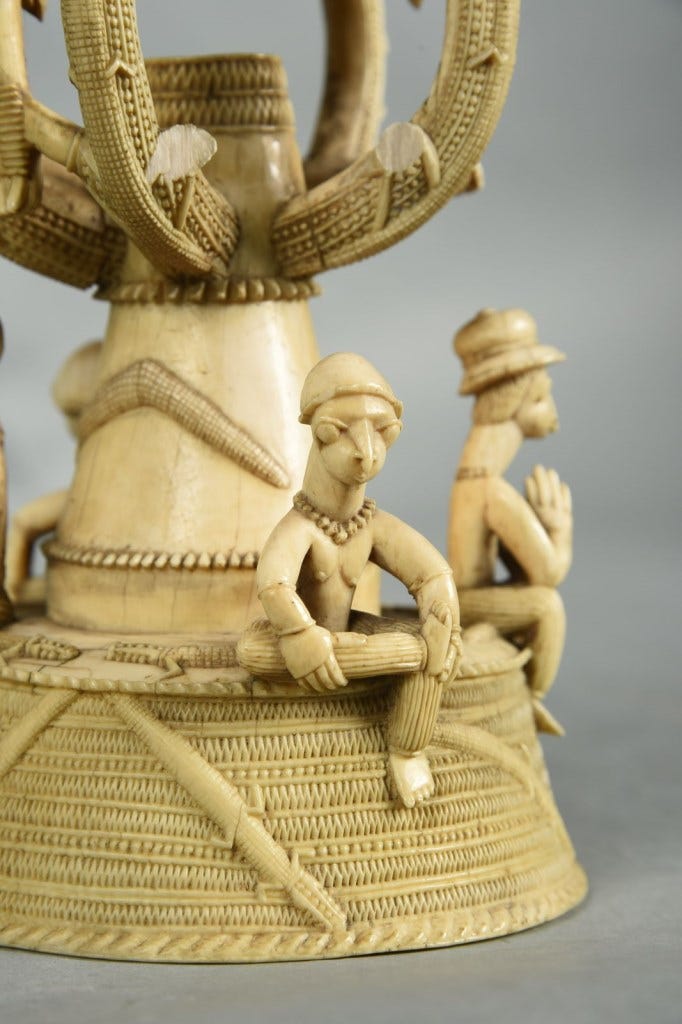
It took years to piece together using French, Portuguese, English, and Spanish manuscripts, printed recipes, tax and price regulations, trade objects, and works of art. Ivory survived more than any other object of this trade. Musk and ambergris dissipated as perfumes, gum arabic disappered into fabrics and tapestries. Pepper passed.
Donne’s elephant was an anomoly. As far as we know, she was the only living elephant to pass through France in the sixteenth century. But the year she spent in Dieppe she was surrounded by thousands of raw tusks and hundreds of hand-crafted ivory objects, many created by African artists.
I love Donne’s notion that this “giant of beasts” is “the only harmless great thing.” That idea sits uncomfortably alongside the terrific beauty of ivory art.
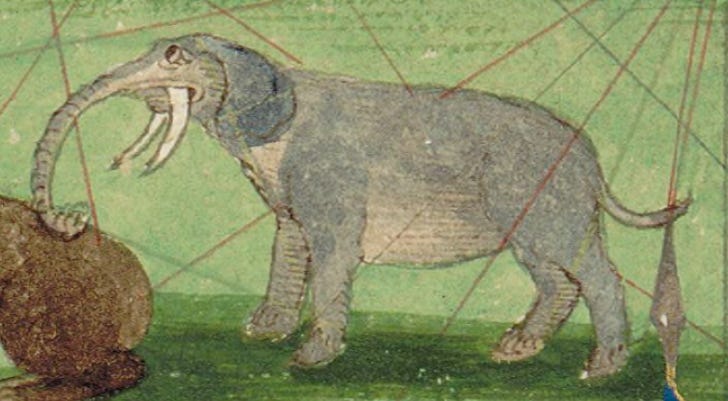
I can’t help imagining that this down-in-the-mouth elephant knew his time was coming: parts of him would soon be carved into a French spork.
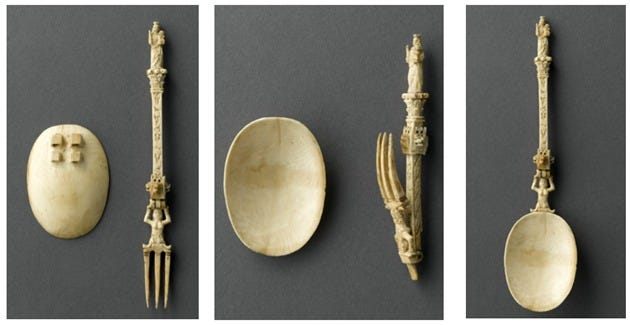
The tension between the very real allure of colonial objects and the equally real violence that produced them became a recurring theme in Beyond the Ocean. But in many of these objects we can also catch glimpses of the people of western Africa as they expressed their cultural and spiritual worldviews. As they chose to represent themselves.