Get Ready With Me!
Makeup tutorials and other Atlantic phenomena in Louis XIV's France

First published in 1656 and reprinted many times during the next few decades, Marie Meurdrac’s La chimie charitable et facile, en faveur des dames (Useful and Easy Chemistry, for the Benefit of Ladies) delivered some pretty hot seventeenth-century takes. Don’t eat mercury, she advised, even if a doctor or apothecary tells you to, because it is a poison and will kill you. Also, and no less provocatively: “Minds have no sex, and if those of women were cultivated like those of men…they could equal them.” Go off, Marie.
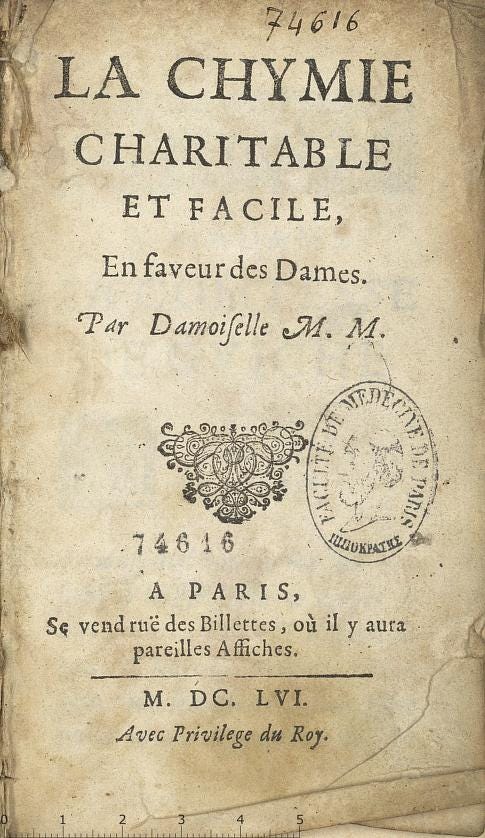
Meurdrac’s chemistry text culminated in a final section (after those dealing with principles, techniques, plants, animal and mineral substances, and medicines) on, of all things, cosmetics. It combined pragmatic and proto-feminist concerns. Basically, she wanted to stop women from “putting things on their faces whose compositions they do not know” by teaching them not just how to do their own makeup, but how to make their own makeup.
A gendered seizure of the means of cosmetic production, however, required access to exotic goods that flowed into France from the Atlantic world. Smallpox scars? A distillation of neck fat from a male pig, bleached oats, and ambergris - a buoyant, waxy secretion plucked from the North Atlantic by mariners who believed it to be whale semen - did the trick. For eau de talc that whitened and tightened skin, Meurdrac turned to the tropics. In addition to talcum powder passed through the digestive tracts of what must have been some very confused snails, she endorsed a mixture of musk harvested from the anal glands of West African civet cats, more ambergris, and Caribbean-grown sugar. For rouge, Meurdrac’s “most excellent” recipe combined brazilwood, cloves, and West African malegueta peppers.
As we embarked on the research for Beyond the Ocean many years ago, neither Brett nor I envisioned ourselves becoming aficionados of seventeenth-century makeup (unless there is something Brett is not telling me). Yet surprising finds such as Marie Meurdrac’s Atlantic-facing line of DIY cosmetics helped us grasp wider themes as well as connections among some important elements of the book’s argument.
For starters: the deep, but never static, history of Atlantic “stuff.” From crusader crocs to the ivory, bullock hides, and "grains of paradise" that swept into French markets in the sixteenth century, colonial objects, goods, and foodstuffs had become increasingly important as markers of wealth and status. Despite the internal and external conflicts that plagued early seventeenth-century France, roguish merchants and the first corporate settlements in Acadia, New France, and the Caribbean kept those goods coming. The well-stocked laboratory where Meurdrac ran her experiments owed its existence not just to her noble patrons, but to Atlantic commerce, while the cosmetics she crafted used the fruits of that commerce to beautify, exalt, and empower the women atop France’s social hierarchy.
Next: Meurdrac’s female readers, we found, exemplified something much bigger. Everywhere we looked, women of all sorts were crucial to the activities - producing, consuming, mediating, and more - that drove French trade and created the kernels around which both French/indigenous relations and the earliest French settlements developed. Tupi women in Brazil, for example, made the spectacular feathered capes that enchanted French observers during diplomatic ceremonies in the 1550s. In the decades that followed, West African and Native American women worked to facilitate trade in pepper, ivory, gum Arabic, and furs. Ordinary French women helped process great hauls of North Atlantic cod, while the likes of Marie Meurdrac combined, consumed, and gave new meaning to higher-toned Atlantic goods. Undergirding this economy, of course, was the trade in enslaved captives - a trade that ensnared West African and Native American women in their thousands even as it enriched a fortunate, well-connected few on both sides of the Atlantic.
In mid-seventeenth-century France, it turned out, female beauty, elite status, and the intertwined growth of Atlantic commerce and racial slavery registered together in all sorts of unusual places. Take, for example, the print below, which dates from the 1670s:

Henri Bonnart, “Dame,” Recueil des modes de la cour de France (c. 1677). Courtesy of the Los Angeles County Museum of Art.
In it, a wealthy, fashion-forward French woman advises her fellow “beauties” who wished to “enhance the brightness of their complexions” to do as she does: “Make use of a Moor.” Here, a member of France’s female elite achieved Meurdrac’s aims by other means - but no less than Meurdrac’s cosmetic chemistry, those means leveraged engagement with the Atlantic world in the service of social status.
So, a little ethnographic work on makeup, of all things, helped us see the sensibilities of powerful seventeenth-century French women from a wider angle. It also served as a reminder of the central role of women in creating an Atlantic world bound together by the social significance of goods and the emerging hierarchies of race.
But along another grain, the Atlantic makeup of Meurdrac’s makeup [plus other stuff] also helped us think differently about the biggest story of her age: the development, beginning in the early 1660s, of the policies, practices, and imagery of Louis XIV’s absolutist monarchy. In his quest to domesticate and overawe the often-rebellious French elite, Louis XIV and the architects of absolutism had little choice but to confront France’s long history of connection to West Africa and the Americas, whose commodities and symbols had informed that elite’s identity and buttressed its claims to a social and political standing equal to his own.