Before (and after) the Code Noir
We should celebrate France’s long-overdue repudiation of the Code Noir. But French racism did not begin with the code and won’t simply disappear with its repeal.


Condemning the Code Noir
Last Thursday, the French National Assembly voted 254-0 to repeal the Code Noir, the edict issued in 1685 by Louis XIV to govern slavery in France's overseas colonies. For over 150 years, the Code provided the legal blueprint for the enslavement and control of millions of people. It defined enslaved people as moveable property, regulated what they could wear and eat, limited who they could visit or marry, and detailed how their bodies would be brutalized if they stepped out of line. But when France abolished slavery in 1848, the edict wasn’t formally revoked: a fact largely forgotten until social justice advocates returned attention to the Code Noir in 2020.
That summer, Guadeloupean activist Franco Lollia, part of the French anti-racism collective known as La Brigade anti-négrophobie, splashed red paint on a statue of Jean-Baptiste Colbert that sits outside Paris’s Palais Bourbon, home of the National Assembly. Lollia tagged the pedestal with the words “Négrophobie d’etat”: state anti-blackness. The act condemned Colbert—who has been memorialized as a key architect of the modern French state under Louis XIV—for building a system of institutionalized racism rooted in the transatlantic slave trade. Nothing symbolized this more than the Code Noir. For Colbert’s role in building the legal infrastructure of slavery, Lollia declared him responsible for a long history of French violence against black people at home and overseas.1
Lollia’s protest followed weeks of debate in France about the fate of statues, place names, and other public monuments that memorialized historical figures now tainted by their association with colonialism and the slave trade. As statues toppled in the US and Britain in the wake of George Floyd’s murder in Minneapolis the previous month, French President Emmanuel Macron vowed to defend the nation’s monuments from the same fate. “The Republic will not wipe away any trace or any name from its history,” he announced. “It will not take down any of its statues.” For many, however, Colbert’s monument served as a constant reminder of persistent inequality in France and its former colonies. Rama Yade, a French politician and human rights advocate born in Senegal, considered Colbert “a great enemy of liberty.” Being forced to pass his statue to enter the National Assembly, she said, was “a microaggression.”2
Historians also weighed in, sparking a heated public debate about Colbert’s relationship to slavery, the Code Noir, and the legacies of racism in France. Only days before the statue was targeted, Jacob Soll, a leading authority on Colbert, wrote in Le Monde that, although Colbert was “clearly responsible” for expanding slavery and the slave trade in his role as minister of finances, he “was neither the main author of the Code Noir nor the mastermind of French slavery.” As he correctly noted, by the time Louis XIV issued his edict in 1685, Colbert was dead. The Colbert who signed the document was his son: Jean-Baptiste Colbert, marquis de Seignelay. Yet Soll wrote appreciatively of the elder Colbert’s achievements while downplaying both the violence of the Code Noir and Colbert’s role in its construction. (Soll has since adjusted his position, arguing for greater culpability and accountability for Colbert regarding slavery and colonialism.)3
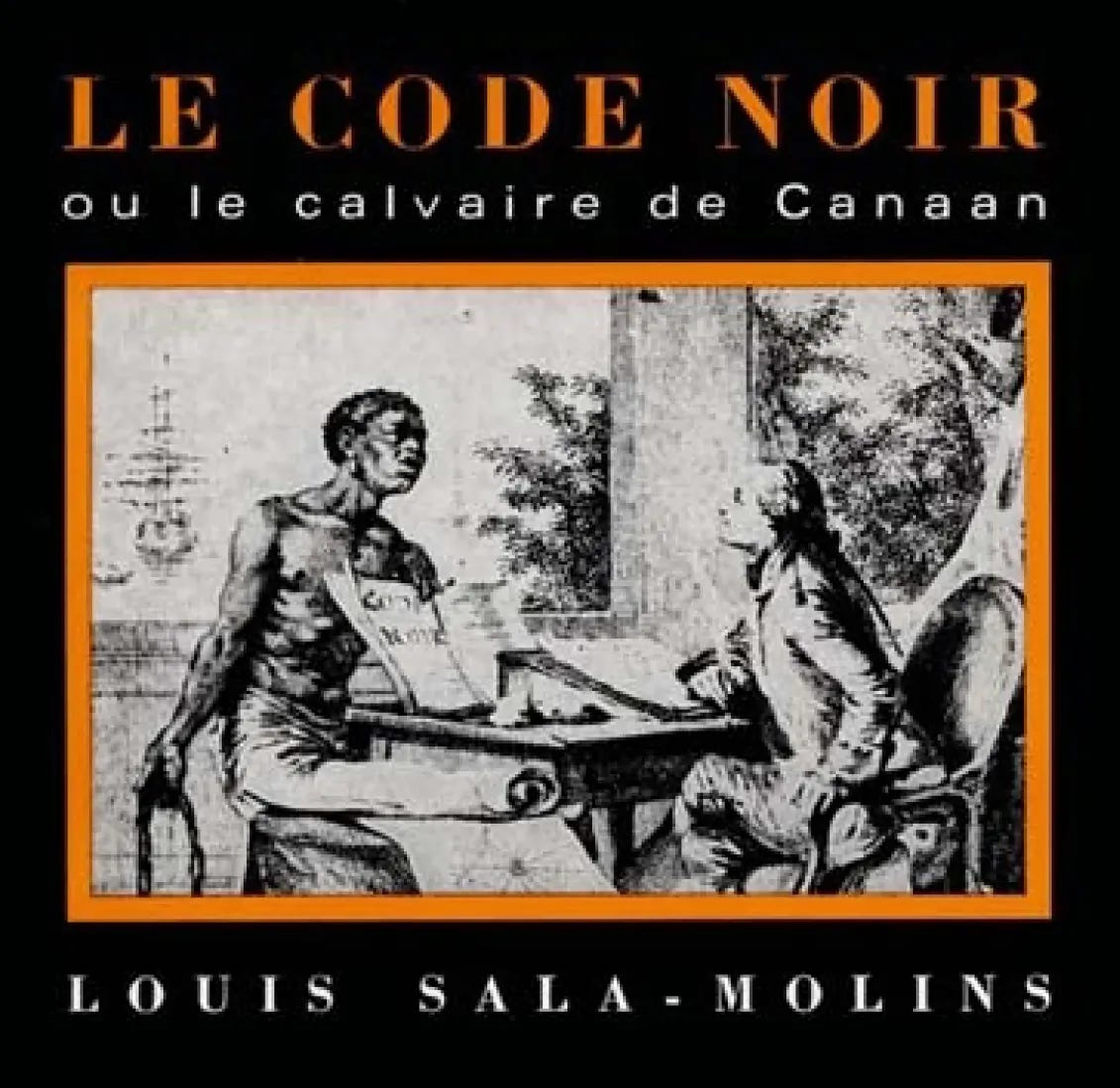
French academic Louis Sala-Molins, a leading authority on the Code Noir, found Soll’s laudatory portrait of Colbert troubling, reflective of the general French unwillingness to confront the horrors of their colonial past or its persistent legacies. He pointed to the many ways that the edict’s language supported violent treatment of enslaved people, including whipping, branding, dismemberment, and even death. The popular notion that the Code Noir offered protections and a measure of humanity to the enslaved was, for Sala-Molins, no more than “a beautiful lie.” However involved he had been in authoring a single edict, Colbert had blood on his hands, aptly illustrated by Lollia’s paint. At his trial the next month, Lollia offered a note of hope. “France is capable of healing from its negrophobia and from its state racism in general,” he told reporters, “but the French state must learn to face its own history.”4
Thursday’s National Assembly vote was a powerful moment of historical reckoning. It held particular importance to French citizens whose ancestors were enslaved under the law. These included National Assembly Deputy Steevy Gustave of Martinique, who celebrated the move but emphasized that it was only a beginning. “No vote alone,” he said in the National Assembly, “can repair centuries of shattered lives.”5
Two Views of the Code Noir: Top Down or Bottom Up?
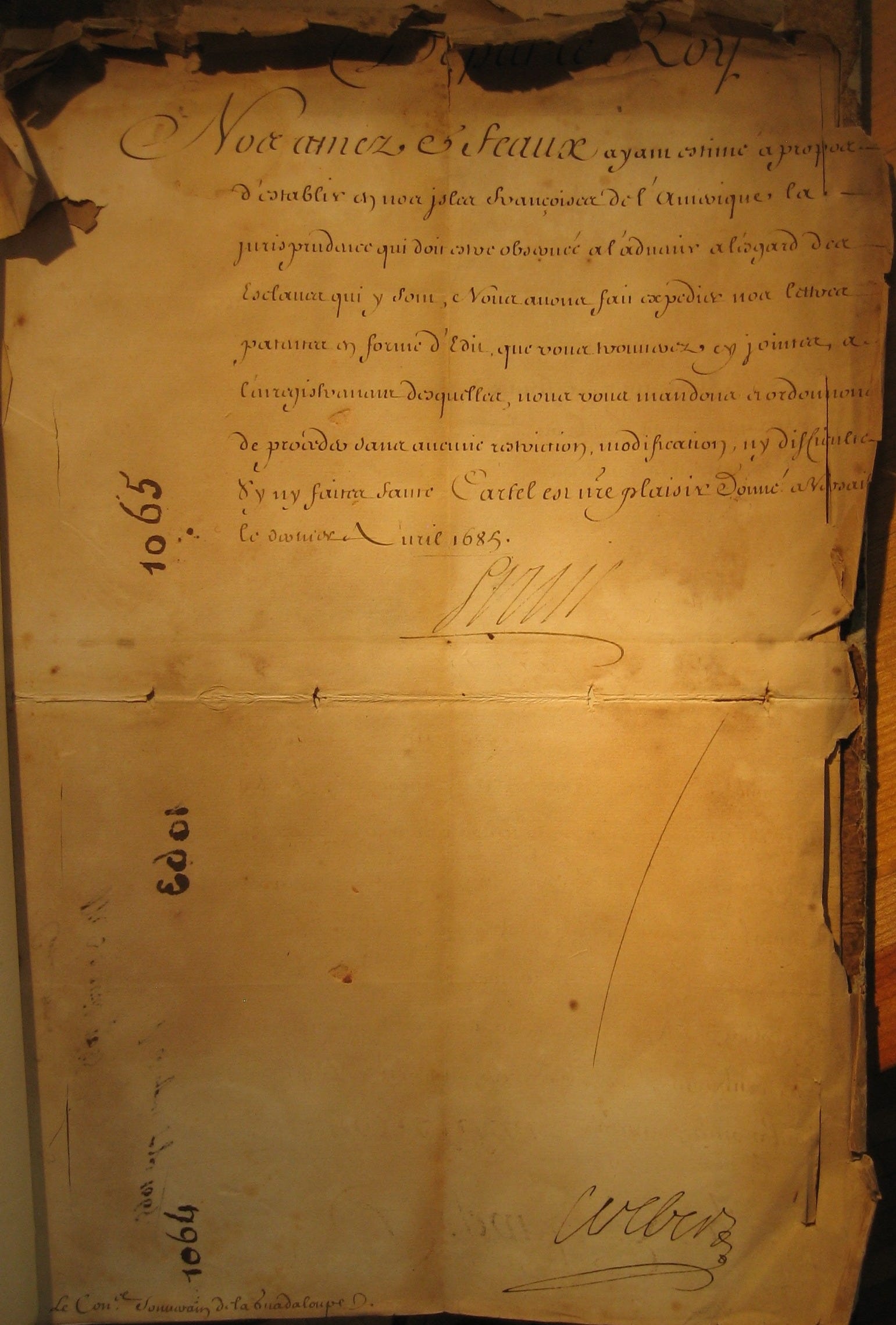
“Our beloved and faithful, having considered it fitting to establish in our French American islands the law that must be observed regarding the slaves who are there, we have dispatched our letters patent in the form of an edict, which you will find attached, which we mandate and order you to implement without any restriction, modification, or difficulty, nor finding fault, for such is our pleasure.”
~Louis XIV and the marquis de Seignelay, describing the Code Noir, 1685
The Code Noir is generally misunderstood in same way that the broader story of early modern French colonialism is misunderstood: by taking kings and bureaucrats at their word. Louis XIV and his minister described the Code Noir—as they described most colonial policies—as an edict created at the king’s initiative and imposed at his pleasure from Versailles onto the colonies. Louis XIV mandated its provisions and ordered strict adherence, without limits, modifications, or complaints.
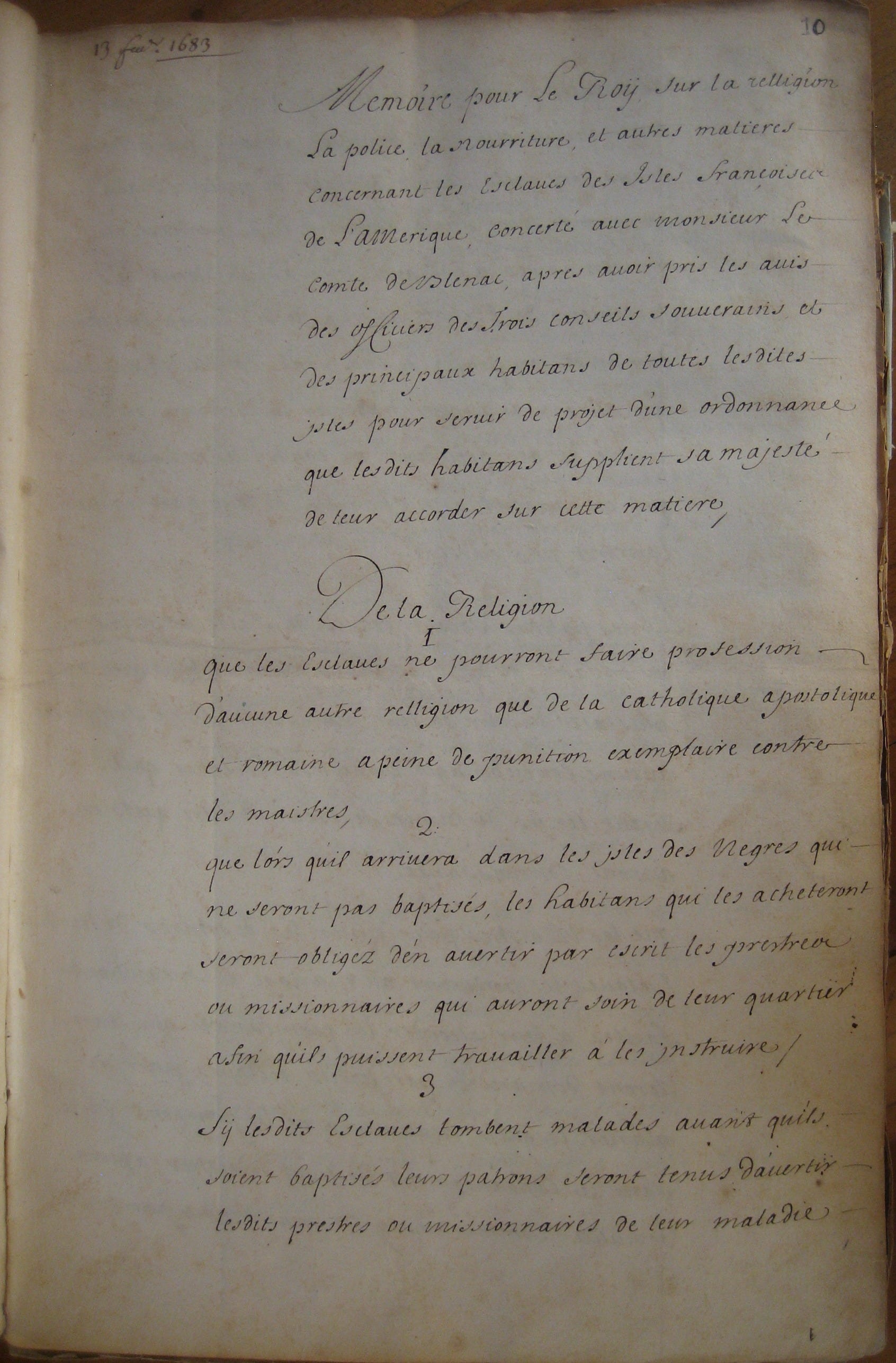
But the Code Noir—like most aspects of French colonial policy—came as a response to the independent actions of French merchants, slaveholders, and colonizers. Widespread demand by private individuals and companies forced state action, not the other way around. Louis XIV’s 1685 edict was nearly identical to a rough draft written for him two years earlier by Michel Bégon, who described the process and provisions of Code in a very different way.
“Memorandum to the king regarding religion, management, sustenance, and other matters concerning the slaves of the French American Islands, in consultation with Monsieur le compte de Blénac, after gathering the advice of the officers of the three Sovereign Councils and the principal residents of all the said islands, to serve as a draft of the ordinance that the said residents begged his majesty to give them on this matter.”
~Michel Bégon, introducing his rough draft of the Code Noir, 1683
It was French slaveholders—especially the richest and most influential—who demanded royal intervention. They had acted independently for decades, engaging in human trafficking, establishing tobacco and sugar plantations worked by enslaved laborers, and incrementally creating regimes of terror one local provision at a time. Rather than an innovation, then, the Code Noir was a summary. It reflected the will of French colonizers and slaveholders as much as the king’s. Colbert, Louis XIV, and the French state undoubtedly bear significant responsibility for the barbarities of slavery under the Code Noir. They invested in and incentivized France’s interests in extractive colonial trade, including plantation agriculture and the global human trafficking system that supported it. But its cruelest provisions arose locally and independently, spreading French culpability and demanding a much wider reckoning.

As we show in Beyond the Ocean, this history has a remarkably deep past. Enslaved people from western Africa and the Americas were brought to France for nearly two centuries before the Code Noir. French participation in the transatlantic slave trade began during the 1530s, long before the French state sanctioned or subsidized it. By the 1560s French ships were engaged in regular human trafficking from Upper Guinea to Brazil and the Spanish Caribbean. The family of the infamous corsair Jean Bontemps had trafficked enslaved Africans for three generations by the 1630s, when Jacob Bontemps (his grandson) invested in the Caribbean island of St. Christophe and the Canadian settlement of New France.

Beyond French Perspectives
If the Code Noir defined enslaved people as property, it also demonstrated their humanity. In its provisions, the law revealed the many ways captives pursued their own interests against French attempts to control them. Their lives are preserved in the text: not only as objects of French terror, but also as actors in their own right. Where the law banned gatherings, it shows that they gathered, and often why. Where the law banned selling vegetables at market, it shows that they grew food for barter. Where the law regulated sex, it shows that they forged intimate bonds across all kinds of presumed divides.
We can’t understand the Code Noir, French colonialism, or the early modern world without looking beyond European perspectives. The enslaved themselves are the most important actors in this story. They were the most numerous, they produced the most wealth, and their lives and labors structured colonial worlds. Reversing the damage of the Code Noir demands a better understanding of the widespread and deeply historical French investment in racialized inequality. It also requires a shift in focus from the actions of the French state to the needs of diverse human communities in France’s orbit.
“Un tag ‘Négrophobie d’État’ recouvre la statue de Colbert devant l’Assemblée nationale,” France 24, June 24, 2020; “Trial begins for man who defaced Colbert statue in Paris court,” Rédaction Africanews, August 13, 2020, https://www.africanews.com/2021/05/10/trial-begins-for-man-who-defaced-colbert-statue-in-paris-court/.
“Macron rejects tearing down statues in France,” France 24, June 14, 2020, https://www.france24.com/en/20200614-macron-rejects-tearing-down-statues-in-france; EXCLUSIF. Rama Yade : “Passer à Paris devant la statue de Colbert est une micro-agression” – L’Express; and [Tribune] Colbert et le Code noir : Un professeur d’Histoire-Géographie répond à Rama Yade - Valeurs actuelles.
« Colbert n’est pas l’auteur principal du Code noir, ni le maître-penseur de l’esclavage français » For Soll’s more recent thoughts, see his essay in Colonisations: nôtre histoire.
« Colbert et son Code noir ne sont pour rien dans l’octroi du statut d’être humain aux esclaves » and “Trial begins for man who defaced Colbert statue.
Thomas Adamson, “France’s parliament votes to repeal slavery-era Black Code, with tears and history in the chamber,” AP News, May 28, 2026.